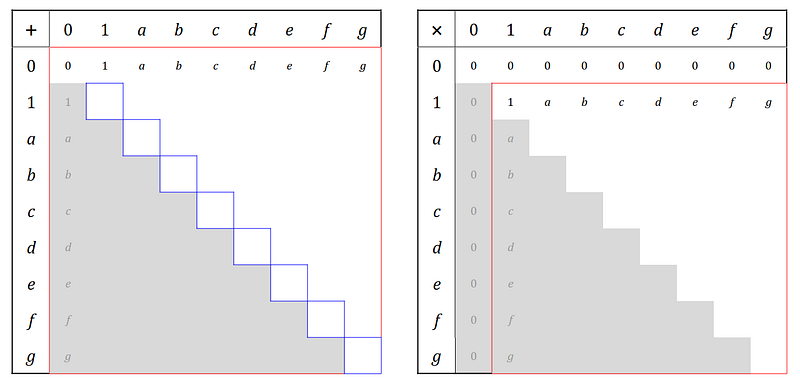
Recently, my brother asked me for help proving some properties that are supposedly true for any field containing exactly elements. If he had looked online, he would’ve quickly found a bunch of general proofs implying that there is exactly one finite field of order up to isomorphism, and that their elements are the roots of some quartic binomial, and that this isn’t a special property of the number . But he asked me, and I don’t know anything other than the field axioms.
is a pretty small number, surely there’s only a couple of fields like that. Let’s just figure them out and check each one!
So we rawdogged it.
A field is defined by its composition tables, which define how addition and multiplication behave on the elements of the field. Thus, the search space is the set of all ways to fill two grids.
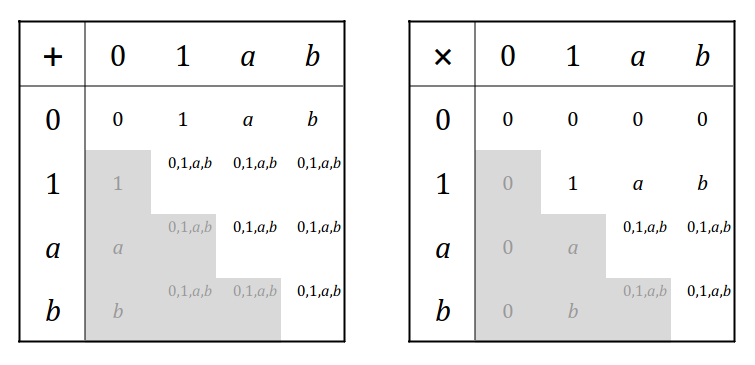
The grids come partially pre-filled thanks to the additive and multiplicative identities. (The proof that times anything equals is trivial.) They’re also symmetric about the main diagonal because addition and multiplication are commutative. So there really isn’t that much left to fill in! Next, we derive two properties from the field axioms:
In English: every row and column (except the row/column in the multiplication table) must contain distinct values. The addition table becomes a Sudoku puzzle, and the multiplication table becomes a Sudoku puzzle, with no sub-grids.
Erm, actually, since there are no sub-grids, these are actually just called Latin squares. But that’s not as fun!
Before we can even start, the multiplication table fills itself:
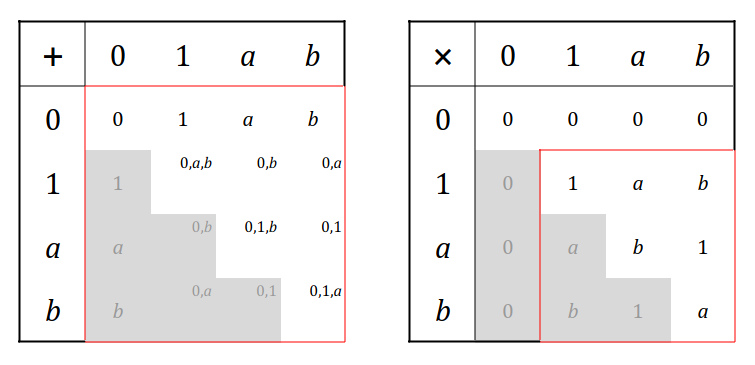
Meanwhile, the addition puzzle still has multiple solutions, even after considering the diagonal symmetry of the grid. However, there is one field axiom we have yet to apply. The axiom of distributivity connects the two grids, and it has something interesting to say:
By consequence, if any of these sums (, , or ) is equal to zero, then all of them must equal zero. By Sudoku rules we know there are 3 zeros left to put in this grid. They either all go on the diagonal, or none of them go on the diagonal. But 3 is an odd number! You cannot place an odd number of things off of the diagonal, without breaking the diagonal symmetry.
So we must place the zeros along the main diagonal, and then the rest of the values instantly fall into place:
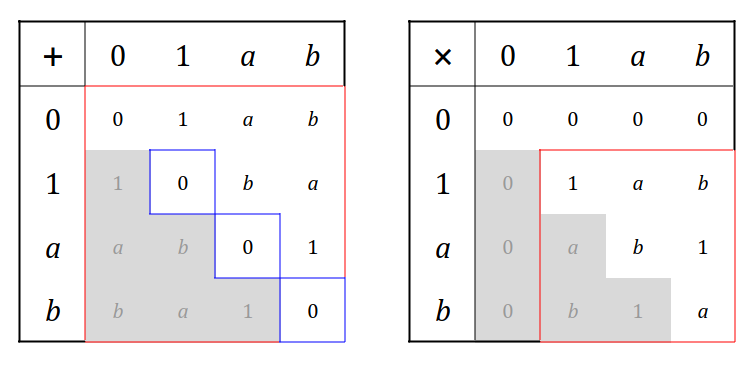
Since we found only one solution, there can be at most one possible field of order . (You still have to verify that the operations fully satisfy the field axioms.) If you have a field on elements, then each of those elements corresponds to one of in the above tables.
Why use big theorem when simple logic do trick?
Of course, this approach doesn’t scale — which is exactly why we use big theorems. But it is a pretty fun exercise for small finite fields… like perhaps?