After going from floor to over the last four issues of mathNEWS, this installment of Stairway Constants covers the remaining floors of the MC north-northeast stairwell number line, in one fell swoop. But first, I should clear up a little something. If you consult any building plan of MC, the stairwell housing the number line is actually dead north relative to the centre of the building, not north-northeast. Either way, you probably know it as the stairwell in the corner of MC with the DC and M3 bridges.
Take this article with you to the th floor of that stairwell. We have an adventure to complete.
Floor
We left off here last time. Between here and the top is about of MC’s height, but only around of the stairwell constants live here. Big numbers just aren’t as special, for the most part.
Just a few tick marks right of the big pink is the first of the last stairway constants.
Freiman’s constant
(For more digits, see OEIS A118472.) Currently years old, Russian mathematician Gregory Abelevich Freiman is Professor Emeritus at Tel Aviv University.1 Around the age of , he discovered this constant’s very weird exact value:
If you handed that expression to someone and told them that it’s the answer to a pretty fundamental question in number theory, I bet they would be very surprised. As with many of the constants in this stairwell, Freiman’s constant has to do with rational approximations. Suppose I gave you a real number . We can measure how well a fraction (in lowest terms) approximates with an efficiency function:2
As we make the denominator bigger, we can get arbitrarily accurate approximations, so approaches zero, making bigger. However, big denominators are hard to compute with, so there is a growing cost associated with the approximation, making smaller. The efficiency function thus indicates the balance between the two. Large values of mean that is both accurate and cheap to compute — the criteria for an “efficient” (good) rational approximation.
For example, last issue we covered as an unreasonably efficient approximation for .
Exercise: what’s the most efficient rational approximation for ? That is, what rational number maximizes ? is pretty darn efficient, but it’s only accurate to digits. This is why mathematicians care more about infinite sequences of efficient rational approximations. Having an infinite sequence means that there’s always another more accurate but similarly efficient approximation further down the road.
Let’s choose an efficiency threshold , and take all rational approximations at least as efficient as . We want to be as high as possible. As long as infinitely many approximations are at least as efficient as , then we have our sequence! This maximum possible value of has a special name: the Lagrange constant , named after the French-Italian mathematician Joseph-Louis Lagrange. isn’t really constant; its value changes with . It indicates how efficiently we can approximate with rational numbers.3 For example, the golden ratio has no efficient rational approximations, so its Lagrange constant is small. In fact, is the smallest of all Lagrange constants.
The set of all possible values of is called the Lagrange spectrum. It starts at , skips to , and skips and skips again. Does it have an end? No, but in 1947, Marshall Hall, Jr. proved that beyond some point, the spectrum stops skipping. Every real number past that point is part of the Lagrange spectrum. 28 years later G. A. Freiman found what that point was, and it is now named Freiman’s constant in his honour. , the end of the last skip in the Lagrange spectrum.
Feigenbaum constant
(For more digits, see OEIS A006890.) Mitchell Jay Feigenbaum passed away recently in 2019. He was an American mathematical physicist whose work on turbulence led him to study chaos. Specifically, Feigenbaum used a simple pocket calculator (highly advanced by 1975 standards) to play with a chaotic recurrence relation called the logistic map. The significance of the logistic map is often explained using a “reproduction” analogy, but given the current state of global affairs, a coronavirus analogy is perhaps more fitting. Let be the proportion of people in the world who are infected with coronavirus today. Each infected person runs into some number of people, and infects of them. The infected person then recovers overnight with probability . Then on average, each infected person today is responsible for infections tomorrow. Let :
This incorrect model gives us exponential growth: . Let’s run with it for now. Even if is person out of billion, this is going to escalate as long as . Grant Sanderson from the math YouTube channel 3blue1brown gives as the current best guess for .
Let’s use the number from Worldometer: active coronavirus cases at the time of writing.4 Then the exponential model predicts less than days until we’re all infected by early June 2020. Obviously, you can see the model falling apart. It falls apart completely by mid-July, when it starts to predict trillions of infections. The key problem with an exponential model is that in a city where everyone’s coughing on everyone else, there should be no new infections because there’s nobody left to infect. In general, more sick people means fewer healthy people you can encounter and infect. Thus, the logistic map is a better model:
As the proportion of infections approaches , the growth should sputter because the proportion of healthy people goes to zero. For now, the spread of coronavirus still looks exponential because continues to be really close to 1, but it makes more sense to label this pandemic as logistic. After all, the logistic model never predicts trillions of people infected.5
Of course, the logistic map isn’t bulletproof. For , approaches some fixed point as goes to infinity. The bigger is, the bigger that fixed point is. Exercise: for , how many infections does the coronavirus stabilize at? Is this a sensible estimate? But once you push past , things escalate quickly. Instead of one fixed point, the number of infections oscillates between a higher and lower number. At Waterloo, that would be as crazy as everyone coughing in your MWF lectures, but the same classmates being healthy in your TTh lectures! From , infections cycle between four numbers. At about 3.544 the cycle doubles in size to eight numbers. It continues doubling faster and faster… At (OEIS A098587) the logistic map loses the plot completely and explodes into a chaotic mess. Every day would have a wildly new number of infections, impossible to draw a trendline through.

Feigenbaum noticed that the distances (, , , etc. in the diagram) between each doubling seem to shorten at a regular rate. Each time it doubled, the next doubling would happen about times faster than the last. That’s why the onset of total chaos comes so soon after . More formally, we can write Feigenbaum’s observation as
where is the Feigenbaum constant. There’s another one (“Feigenbaum’s second constant”) that is less talked-about than this one. Why is this one cooler? From the diagram you can see that the graph of the logistic map’s points of stability is like a fractal. One point of stability splits into two branches, which split and split and split again. In fact, Feigenbaum’s constant shows up in all sorts of other fractals. Most famously, it’s the ratio between the sizes of various self-similar blobs in the picturesque Mandelbrot set.
Floor
Five. V. Olympic rings, toes, platonic solids, senses (in the classical sense), and categories of hurricanes. Google “star” and you’ll see a bunch of five-pointed, probably-yellow figures used in many rating systems (which are also often out of ).
The centuries-old Goldbach’s weak conjecture states that is the last odd number that can’t be written as the sum of three (not necessarily distinct) prime numbers. It is generally accepted that the Peruvian mathematician Harald Helfgott achieved the first proof of this in 2013.
There are less than constants left to explore. What are we waiting for?
Volume of the unit sphere in
(For more digits, see OEIS A164105.) The plaque is wrong! If you punch into any respectable calculator (or just check the OEIS), the digit 3 in is not supposed to be there. is the correct value. How many other errors are there in this stairwell? I’m not going to check.
There are a bunch of ways to derive the volume of the unit sphere in yourself. In homage to the next constant up ahead, the volume of the unit sphere in , I’ll show you a way to compute it from that number.
For some yet-unspecified , let be the volume of a sphere of radius in the -dimensional space . Just like how we can cut a sphere in dimensions into a stack of circular slices, we can cut a -dimensional sphere into a stack of -dimensional spherical slices.
If the centre of the -D unit sphere is at height , then its bottom is at and its top is at . As is true in any number of dimensions, the Pythagorean theorem tells us that the slice at height has a radius such that . Rearranging, we can isolate . Thus, the volume of the -D unit sphere is
You can solve this integral through trigonometric substitution! Draw a line between the origin and the -D sphere at arbitrary height . It makes an angle with the plane . Thus, and .
Exercise: finish evaluating the integral by using the double angle formula . You’ll need it more than once! At the end, a bunch of terms cancel out and you get . (Notably, is slightly less than …) Now what was again?
Volume of the unit sphere in
(For more digits, see OEIS A164103.) (The last digit on the plaque is off by …) Aha! That’s what is. is the volume of a -D sphere of radius . Now we can plug it in and finish computing the volume of the -D unit sphere:
as we saw earlier.
As mentioned in the discussion around the stairway constant , the 5D unit sphere has the largest volume of any unit sphere in any number of dimensions. Why? Suppose that instead of finding the volume of the unit sphere in 6 dimensions, we wanted it in dimensions. We could set up a similar integral and use trigonometric substitution again:
Each volume is times the previous. Stepping back from the integrals, represents the area under the curve between and . What do the graphs of look like? Without even graphing, you can probably fill in some common points like and . After graphing, you might notice that the graph hugs closer and closer to the -axis as you increase . Exercise: why? If , prove in the range of our integral, except at the common points mentioned above.
This means is strictly decreasing with . For , the area is greater than . Therefore, increases for , because . However, at , drops below and just keeps plummeting all the way to . These two things together are why the -D unit sphere has the greatest volume.
Floor
As you reach another big pink number, you realize that this time it only took steps, breaking the pattern of steps per flight that’s been in force since floor . It stays that way for the rest of the stairwell.
Floor
Six. “Habitable” floors of MC. Legs on an insect. Faces on a cube. In fact, if you look directly at the corner of a cube, you’ll see a hexagon. Hexagons (irregular) tile all across the facade of QNC to represent the structure of graphene. sides is the most that a regular polygon can have and still be able to tile the plane.
is a really nice number. You might even call it sexy.6 It’s a perfect number, because its divisors , , and sum to its value (). Most numbers don’t have nearly enough divisors to do that.
Up from here, the stairs narrow, leaving a gap for you to look down and marvel at all the steps you’ve climbed to get here — but we’re not at the top yet.
Tau
(For more digits, see OEIS A019692.) On June 28, the rebel scum of mathematics gather for their annual unconventional convention. Why June 28? It marks the day that the first three base- digits of (a.k.a. ) coincide with the Gregorian calendar. The cult has made a name for itself by denouncing the celebrated circle constant in favour of its one-legged counterpart . Their goal: to replace with and with in common and academic discourse. They cite a plethora of reasons, including:
- is the ratio between the circumference of a circle and its radius, which is much easier to state than the diameter nonsense used to define . This gets us really nice angle notations like to represent 90 degrees, a quarter of the way around the circle.
- The period of the sine and cosine functions is .
- A lot of formulas that contain actually use , which can be written more succinctly as . For example, take the stairway constant from last installment.
- Euler’s formula becomes .
- A bunch of physics I’m not qualified to speak about.
- Contrarianism is good for press.
You can find a whole lot more at tauday.com. Unfortunately for the rebels, their campaign barely makes ripples in the face of the establishment, because…
- looks uglier.
- tastes better.
- It doesn’t matter. Even if all literature and people switched to overnight, we wouldn’t gain any new insights into mathematics.
- Inertia.
Or maybe I’m wrong, and will be the fashion in another ten years. After all, the movement started only ten years ago when Michael Hartl published the Tau Manifesto online and introduced as the symbol for this previously faceless constant.
For serious reasons why is worth defending, you can alternatively find the Pi Manifesto.
Exercise: celebrate March 14th by throwing a pie at your local supporter!
Floor
Just a little further…
Froda constant
(For more digits, see OEIS A262993.) This constant manages to escape the mostly-exhaustive coverage of Steven R. Finch’s Mathematical Constants. Apparently, in 1963 the Romanian mathematician Alexandru Froda exhibited a proof that this number is irrational, but I can’t find the paper. All sources that mention this proof also add a mysterious remark that nobody (not even Froda, if he were still alive) knows whether the proof is valid.
In general, it is very hard to prove if a number like the Froda constant is rational. The problem is the weird composition of crazy numbers. Other numbers whose rationality is unknown include various spellings of “pie” like , , , and . That said, we do know that and are definitely irrational, since they are transcendental.
Exercise: prove or disprove whether the Froda constant is irrational.
Floor
Seven. The most random number between and . The number of members in Maroon 5. There are seven sides on a regular heptagon, the simplest polygon that can’t be constructed with compass and straightedge alone.
You stand upon my favourite spot in all of MC. It’s pretty spacious up here. The gap between the stairs lets you look down and get a true sense of how high up you are: steps above floor . The stairway constants, the big pink numbers, the hundreds of tick marks… they all spiral away below you. Heck, not even eduroam makes it up here. This place is sacred. Adding to the heavenly feel, beautiful lights shine up from the walls to illuminate the ceiling.
The stairway constants are done, and I hope you’ve learned something along the way. Slightly to the right of the big pink , the number line ends just as it started — it runs straight into the wall and stops. I guess Peano was wrong after all, and Randall Munroe was right — there really aren’t any numbers above . Maybe if they made MC taller…
Despite the huge pipes that run straight through the number line, it’s not too loud up here. If you listen closely, you can hear the invisible dragons that nest on the roof of MC. “Thanks for not taking the elevator,” they whisper.
This was the final math-heavy installment of Stairway Constants, to the great relief of the mathNEWS editors. Only later did I understand the amount of insane manual work involved in typesetting those formulas in Adobe InDesign when importing my article submissions. Nevertheless, swindlED awarded the v142i5 article of the issue to me for this series, with the following note:
This week’s article of the issue goes to water for Stairway Constants, part , though really it’s for the series as a whole. On the one hand it’s the most actual math we’ve had in mathNEWS in a while, on the other hand the Stairways Constants series have been by far the hardest articles to format since Zethar’s cuneiform magnum opus, so you best be damn grateful we’ve deigned to give you the prize 😛
Also, my friend Cix drew the most amazing cover art for the v142i5 issue in honour of the finale:
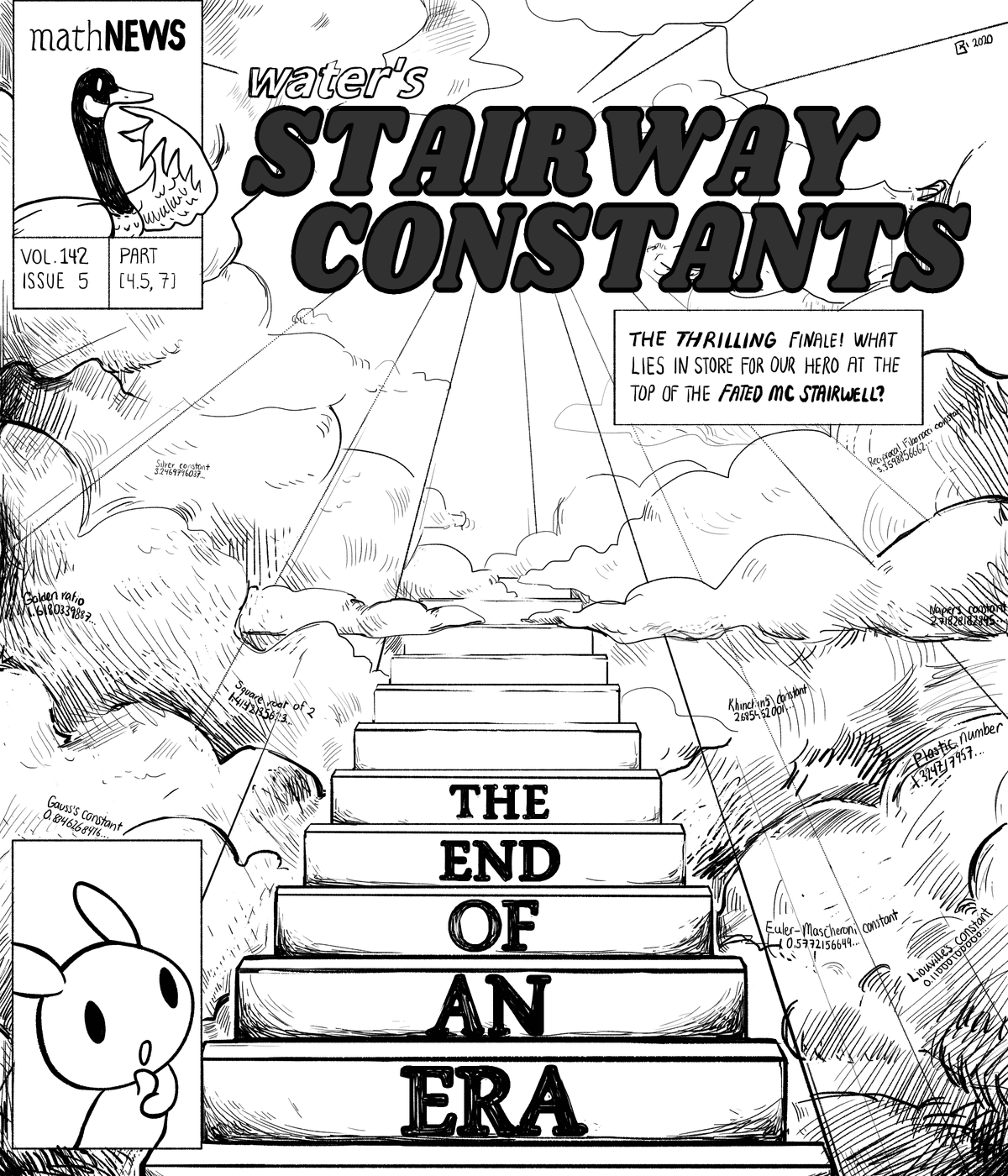
THE END OF AN ERA was no understatement — it defined not just the term but perhaps my entire pre-COVID university experience. I sank more effort into the series than most of my courses. It also had an unintended meaning: the incoming pandemic then closed the university on the very same day.